

Do Not Feed the Fire
Hearts of Iron, Atomwaffen, and the Problem of Rehearsal

Content warning: depictions of far-right extremism and mass violence.
I was sending my troops into the Florida panhandle when I clocked the date. It was December 3, 2022, and my divisions had spent the last several in-game days fighting toward Tallahassee. Right around here, on this exact real-life day, I’d stood in my cousin’s backyard and watched her get married. The word “hyperstition” kept coming back into my head over the next few weeks.
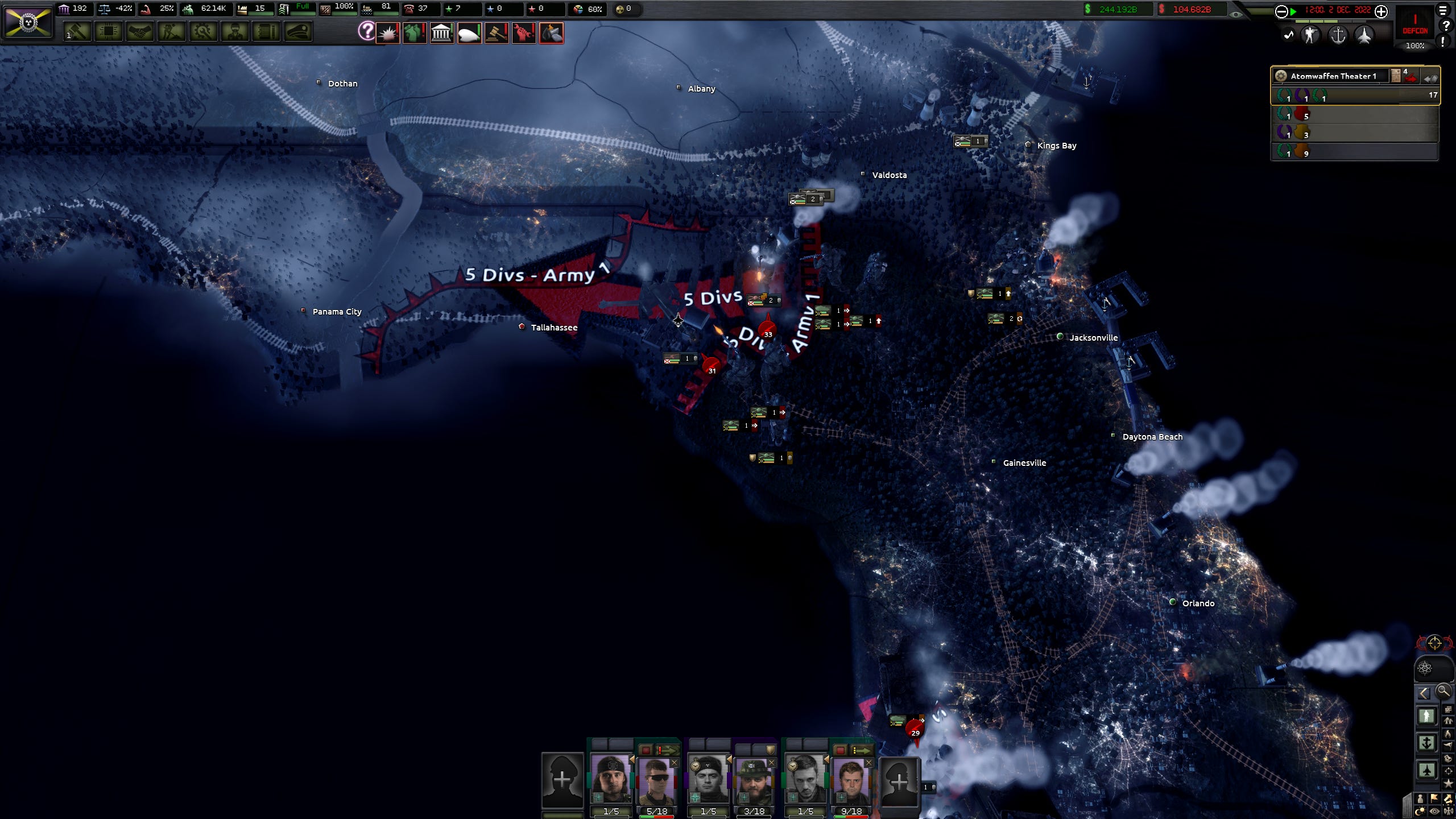
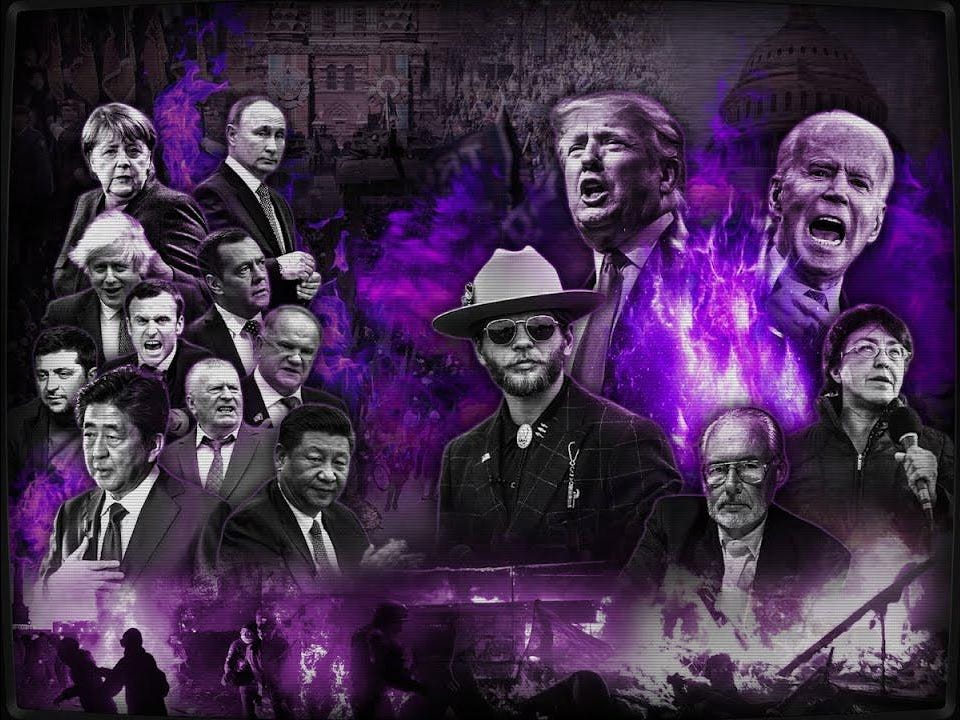
Like other fan-made “total conversion” mods for Hearts of Iron IV, The Fire Rises swaps out the original strategy game’s World War II setup in favor of something completely different. Unlike most similar mods, that something is an alternate 2020s. Starting on 1/1/2020, TFR lets you play your way through any number of contemporary “what-if” conflicts—most notably, a second American Civil War. One of the mod’s best bits of worldbuilding is the abbreviation it gives this long-imagined hypothetical: “2ACW.”
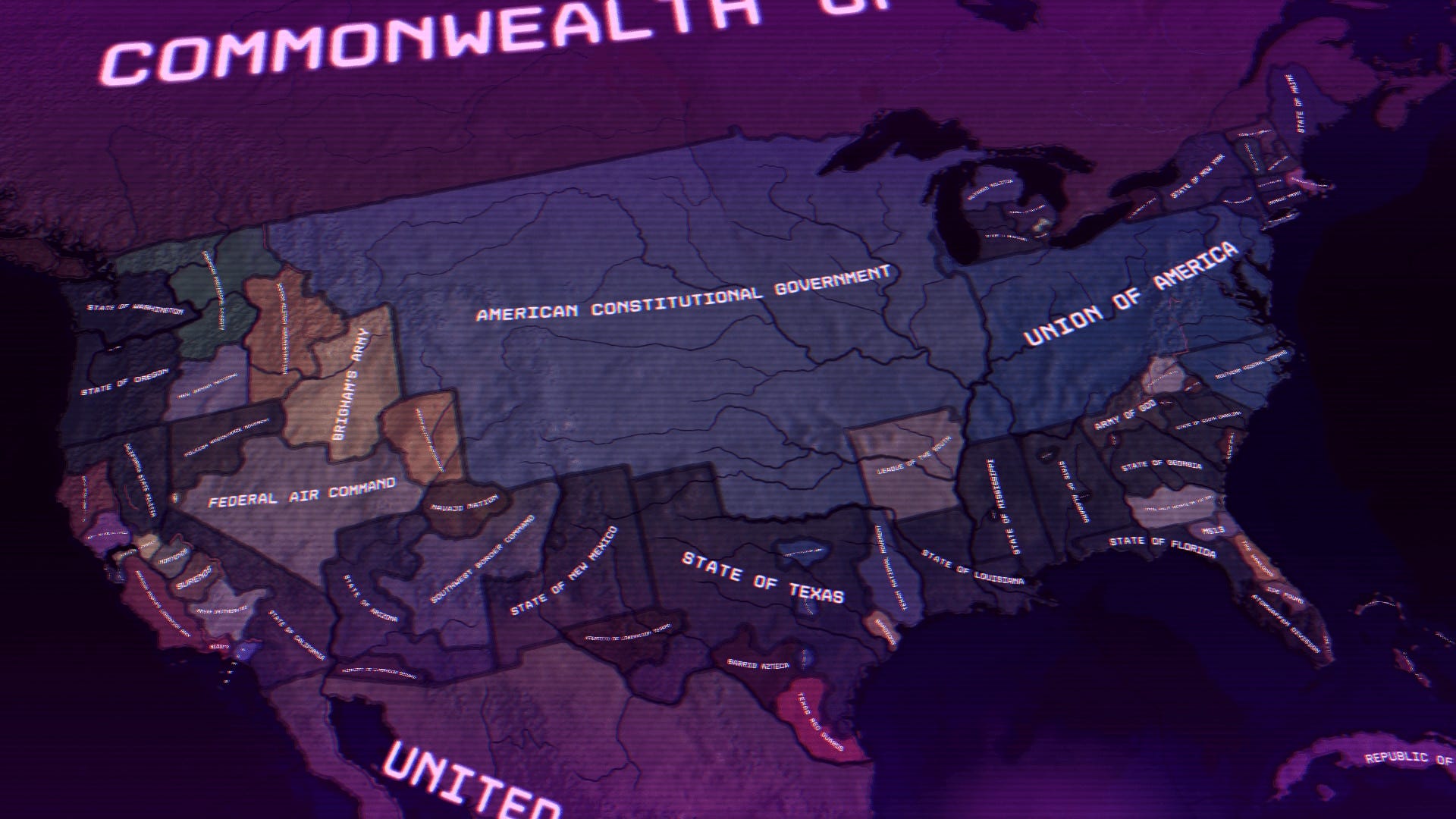
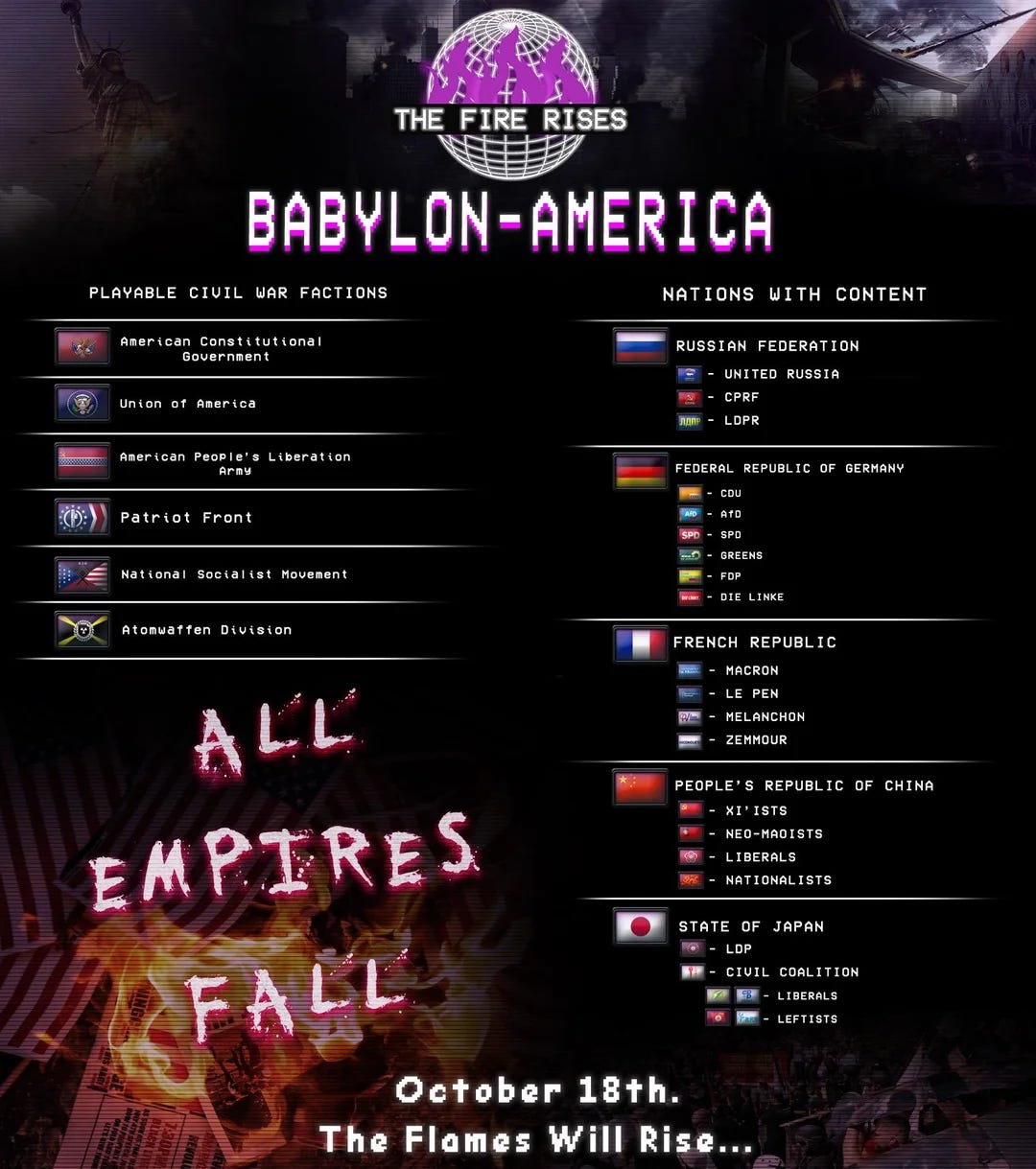
While it’s possible to play as any real-life country on Earth as of TFR‘s start date, only a few dozen have the fully-realized “focus trees” (a mix of domestic and foreign policy decisions with in-game pros and cons) that any good HOI4 faction is built around. One of the mod’s central quirks is that several of those fully-realized factions are real-life far-right extremist groups. When the 2ACW breaks out, the far left gets the hypothetical big-tent “American People’s Liberation Army”; the states loyal to Trump become the “American Constitutional Government”; and the states loyal to Biden become the “Union of America.” All three are populated with real-life politicians, generals and media figures. But the mod also lets you play as the National Socialist Movement, Patriot Front, and, most curiously, the Atomwaffen Division.
Of course, some of TFR’s apparent emphasis on the real-life far-right may be a legacy of its creators. The mod’s original lead dev, appropriately known as “Czar,” has never been shy about his fondness for neo-Nazi memes and rhetoric. This is part of what led to his ouster from the dev team in the spring of 2025, just five and a half months after the mod went live on Steam, alongside concerns about broader governance and possible monetization. Most of his pet projects — including one in-game path that would allegedly include the literal second coming of Christ — were scrapped on his way out, and the post-Czar team has been actively expanding the mod’s ideological scope. The next major planned update, “The American Experiment,” adds playable content for several left-wing and anarchist factions, as well as new material for the far-right. This course correction suggests that most of TFR‘s current developers aren’t trying to build a tool for recruitment or radicalization. What I want to argue, as someone who enjoys playing TFR and has no plans to stop any time soon, is that this matters less than you might think. Unfortunately, this will require spending a lot of time talking about some very sick people.
Penance
Atomwaffen — German for “atomic weapons” — is a neo-Nazi accelerationist network that emerged from the internet forum Iron March around 2015. Drawing on James Mason’s Siege, a newsletter-turned-book which advocates abandoning organized neo-Nazism in favor of decentralized lone-wolf terror, they preach that Western civilization is too far gone to reform and that the only meaningful political act left is to hasten its collapse. Critically, unlike many other online political types who profess similarly extreme beliefs, they’re not LARPers: several members have been convicted of murder, and several countries have designated the group as a terrorist organization. Mason himself was added to Canada’s list of designated terrorist entities in 2021, only the second individual ever to make it.
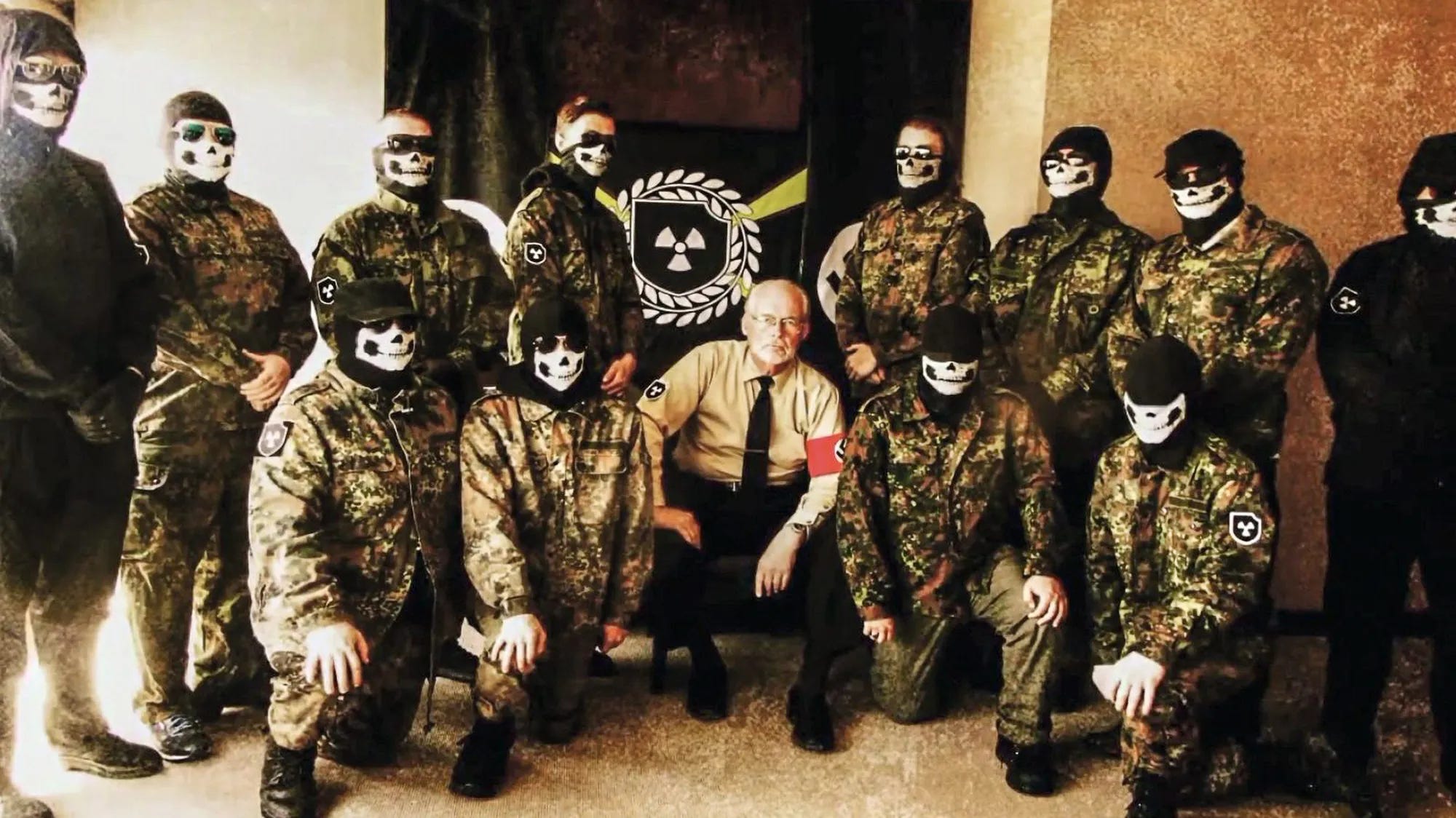
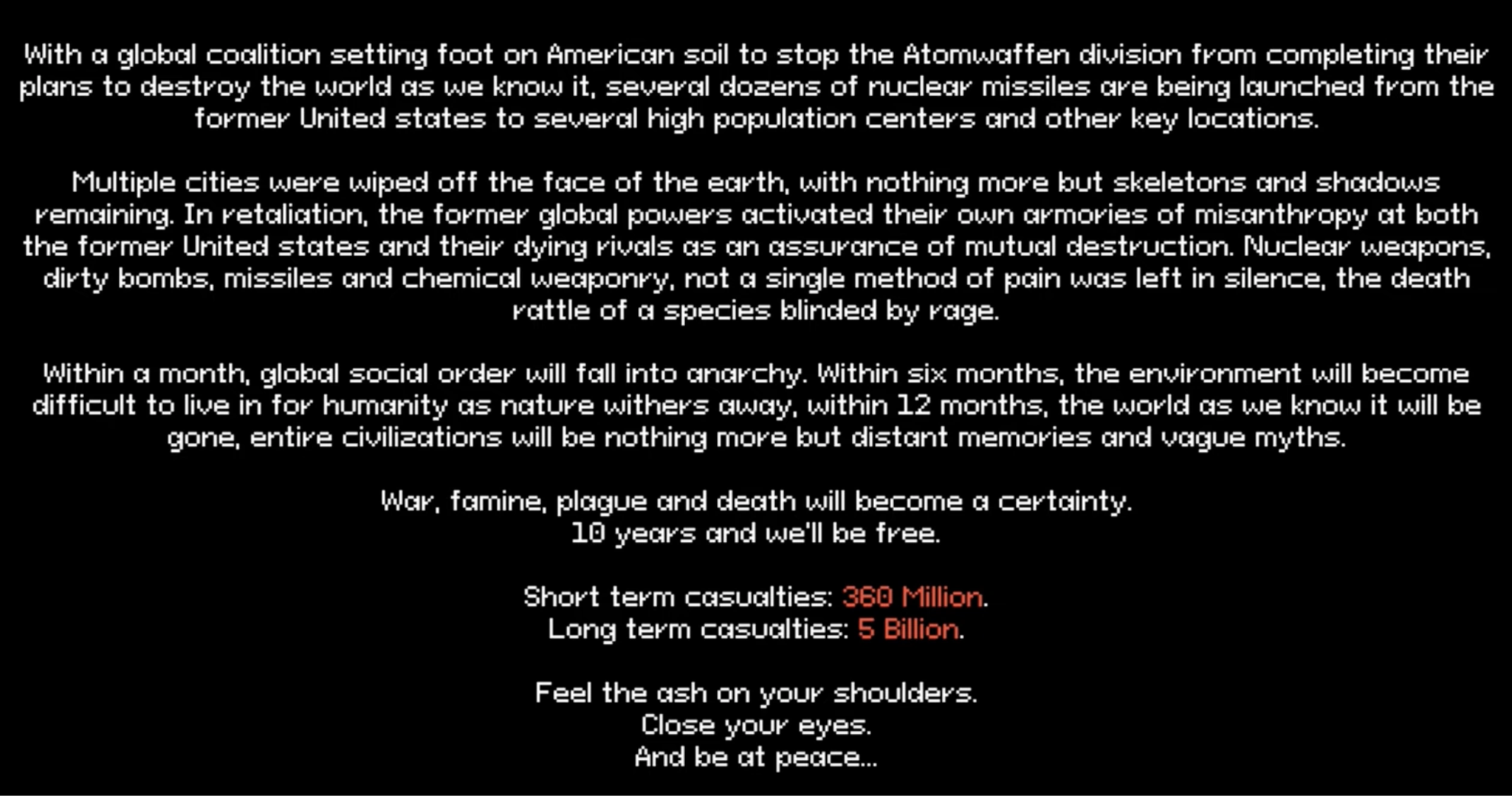
It’s also a relatively small group, with membership peaking at around eighty across roughly twenty states in the late 2010s. This is consistent with the leaderless-resistance doctrine they inherited from Mason, but it’s probably also some reflection of their openly apocalyptic objectives. Because TFR tries to represent and extrapolate these objectives faithfully, Atomwaffen is the only faction in the mod whose victory ends with self-inflicted nuclear war: if they win the 2ACW, they declare a “Great Aryan Crusade” against the UN, weather an international intervention while building bunkers and stockpiling supplies, and then launch every missile in America’s arsenal in an attempt to end the world as we know it. Once the player reaches this point, after completing dozens of prerequisite focuses and spending most of a full real-life day behind the keyboard, they are presented with the following title card.
The existence of this ending was one of the first things I ever learned about The Fire Rises—and when I installed the mod, my initial morbid curiosity drove me to start with an Atomwaffen playthrough. I quickly discovered that the faction’s punishing victory conditions come with an equally punishing difficulty curve. While the Trump-led ACG and Biden-led UoA inherit most of the U.S. armed forces and large competing blobs of territory to match, Atomwaffen begins the 2ACW with a modest sliver of central and southwest Florida, a ragtag group of “Aryan” irregulars, and a mix of homemade weapons and looted National Guard equipment. Even in a world where the COVID-19 pandemic proves orders of magnitude more deadly and socially destabilizing than the one we got, the idea of a group like this occupying a quarter of America’s third most populous state is a massive stretch—and even with this head start, the faction is reliably snuffed out by midgame in most non-Atomwaffen playthroughs. This is exactly what makes them such an interesting challenge for any seasoned Hearts of Iron player.
Compared to podcasts like TrueAnon and investigative journalism programs like Frontline, TFR offers a very different kind of introduction to Atomwaffen. Rather than viewing the group’s members, leaders and ideology from a reporterly or academic distance, the mod puts you squarely inside their heads and makes it clear that the only way to succeed is to do as they would do. Where a Union of America playthrough might make you choose between increasing defense spending or expanding social services, an Atomwaffen playthrough pushes you toward flooding the internet with ISIS-style execution videos to traumatize your new subjects into submission, or setting off nuclear weapons in major cities controlled by your rivals. All of these decisions come back to the real-life Atomwaffen’s accelerationist ethos: dragging the world further into the kind of chaos they need in order to succeed. The group’s inclusion in the mod is sometimes read as a joke, and their in-game tendency to collapse under their own contradictions without player intervention makes the joke land. But there’s nothing funny in a winning playthrough.
When you finish conquering Florida — the first big step toward the infamous “Endsiege” game-over screen — you unlock a range of new focuses meant to help you take on your more well-organized neighbors. One of these decisions, available at the earliest levels of the focus tree’s military branch, is called “Begin the Liquidation.” Unlike other focus decisions, which come with blurbs of explanatory flavor text, the only context you receive here is an image of a tank overlaid with bloody handprints—plus some in-game stats. When chosen, “Begin the Liquidation” makes other factions view Atomwaffen with more suspicion, makes Atomwaffen’s subjects more compliant and less likely to resist, and enhances the attack power of all Atomwaffen divisions. The real storytelling begins once the focus is completed, triggering an in-game event called “Solemn Penance.”
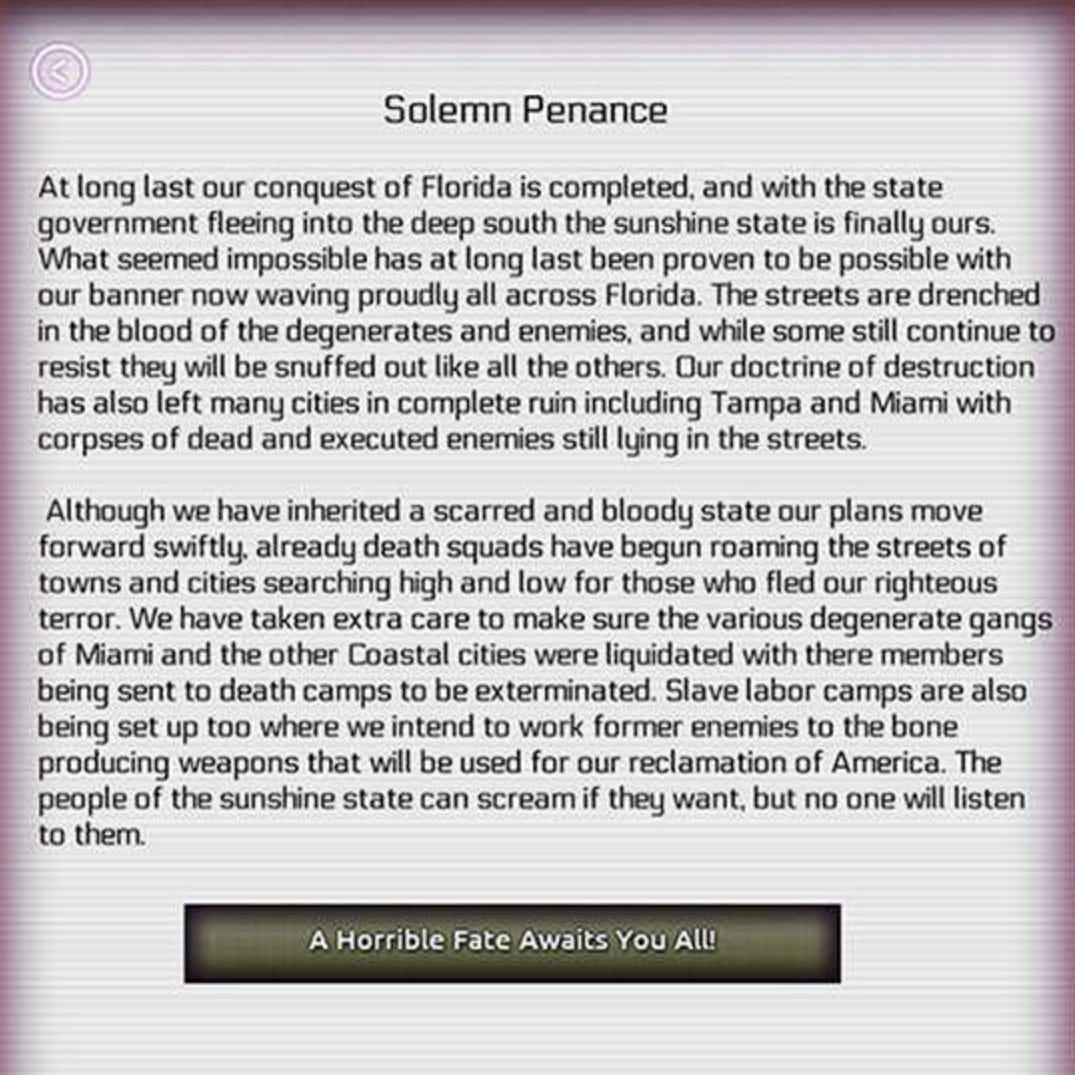
Upon clicking the button labeled “A Horrible Fate Awaits You All,” the player is informed that they’ve just lost 75,000 manpower—Hearts of Iron’s metric for the number of people in your territory suitable for military service. This is a fairly euphemistic way of reporting the early death toll from the “liquidation” you’ve just chosen to begin, and notably omits anyone deemed unfit for Atomwaffen’s ranks. While I had already made several equally grisly decisions to enhance my odds of winning by this point in my first playthrough, reading that figure made me wonder if I should switch to a less openly sinister faction. It’s strange to play a game about conquering 2020s America in 2020s America, and it felt even stranger to be told I was presiding over war crimes in a place where someone I love got married—but if there’s a point where that strangeness is enough to make me stop playing, I still haven’t found it.
I’m not here to rehash the debate over whether The Fire Rises is “dangerous content.” For better or worse, it exists, it will continue to exist, and it’s fun in all the ways a well-made grand strategy total conversion mod should be. The far more interesting question is how the mod’s underlying mechanics work on people—and what that can tell us about the whole field of grand strategy gaming.
Capture
When I started thinking about how to talk about The Fire Rises, one name immediately came to mind. The Birth of a Nation is not an unloaded title to invoke in a piece like this, and it doesn’t map cleanly onto a grand-strategy total-conversion mod. Still, it’s a familiar story about how an object can be adopted by a movement beyond the control of its original creators—and in that sense, it’s worth revisiting.
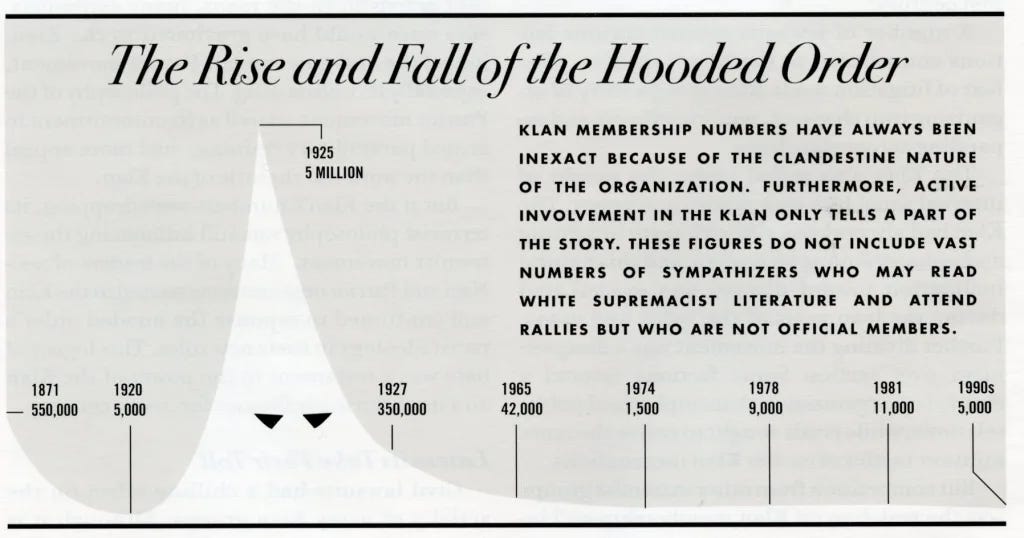
D.W. Griffith’s 1915 epic is widely credited with inventing the grammar of American moviemaking, but it’s equally famous for resurrecting America’s most infamous white supremacist group. In the decade after the film’s release, the Ku Klux Klan grew from a dead Reconstruction-era memory into a nationwide movement that could march tens of thousands strong through Washington, DC—and many of those new members first encountered the group at their local movie theater. The critical detail here is that the creator’s intent and the object’s potential uses were aligned from the start. When Griffith decided to adapt Thomas Dixon’s novel The Clansman: A Historical Romance of the Ku Klux Klan, he knew exactly what he was doing. The film was tailor-made for the real-life movement; all they had to do was show up and accept their gift.
Any movement can capture a sufficiently faithful, workable simulation of itself, even if that simulation is meant to be unflattering—which is not to say that The Birth of a Nation is a perfect analog for The Fire Rises. While the film depicts its chosen movement as heroes, the mod presents its most openly malevolent factions as a challenge—both to the player’s gaming abilities and their conscience. But as any Dark Souls player will tell you, punishment can be a ludonarrative love language in its own right.
If The Birth of a Nation’s Klan seduces the viewer through cinematic pleasure — using the most advanced filmmaking techniques of its time to make the viewer identify with the Klan even if they don’t initially want to — The Fire Rises’s Atomwaffen seduces the player through the pleasure of mastering something difficult. For anyone who chooses to take the mod’s challenge seriously, it’s also filled with detailed, if slightly gamified, working models of how groups like Atomwaffen understand themselves and their projects—and as the post-Czar team continues to add more factions to the roster, the mod will only cast a wider net.
Affordance
To understand how The Fire Rises really works, we need a new term for what happens when a participatory simulation models a contemporary political project — populated by people who can still see themselves — with the project’s operational logic still largely intact and workable. Call this a capture affordance: the property that allows something like a grand strategy total conversion mod to be inhabited by the movements and individual actors it depicts, as well as by those who spectate and actually play it. Critically, this is not the object’s sole reason for being; the affordance is a side effect inherent to the form but not a foregone conclusion.
I’d be remiss not to acknowledge the work of another writer who has spent a lot of time exploring this subject. In his 2007 book Persuasive Games: The Expressive Power of Videogames, the academic and game developer Ian Bogost presents the concept of procedural rhetoric—”the art of persuasion through rule-based representations and interactions rather than the spoken word, writing, images, or moving pictures.” For Bogost, every in-game rule has the potential to make a claim about how the real world works—and by crafting those rules in a particular way, game developers can convey a specific ideology to players. While Bogost’s work tends to focus on developers who deploy this intentionally, I’d argue that its broader effects are mostly accidental.
What sets Bogost’s procedural rhetoric apart from capture affordance is a matter of distance and direction. The capture affordance that makes a player internalize the rules of a grand strategy game operates on the same logic Bogost describes, but it applies only when the system being modeled is a present-day movement. Critically, the persuasion can also go both ways. The depicted group can capture the object, and the object can capture whoever picks it up. How that plays out depends on who is on which end of the transaction.
While it’s impossible to verify that TFR‘s dev team doesn’t include any actual Atomwaffen members, it’s safe to assume that the mod’s version of AWD was built by piecing together elements of the group’s self-presentation, stated ideology, key texts, and documented operational structure. It also has to check the boxes of working as a playable video game faction—and while fun and realism are not mutually exclusive, smart developers know when to concede one for the sake of the other. TFR‘s Atomwaffen is not the real Atomwaffen; the model you consume while playing is more of a working abstraction (“TFR-AWD”), and that makes TFR a less-than-perfect tool for the real-life group. However, the mod’s fidelity to its source material still runs deep enough to do some strange things.
When playing as TFR-AWD, the player is eventually required to align with one of three internal subfactions — pure Accelerationists, Christians, or Satanists — each with its own leadership, goals, and starting popularity. Every major TFR faction offers a similar midgame split for the sake of enhanced gameplay variety, but the options available to the would-be Atomwaffen player are especially curious. For example, if the player chooses the Satanists, they eventually stage a coup against James Mason and replace him as leader with Joshua Caleb Sutter.

The real-life Joshua Sutter is a book publisher with a background in white nationalist, satanist and “esoteric Hitlerist” groups like the Order of Nine Angles. He became one of Atomwaffen’s key leadership figures in the late 2010s and is credited with heavily influencing the aesthetics and practices of many other Nihilistic Violent Extremist movements. He’s also a noted FBI informant, and was compensated more than $140,000 by the federal government between 2003 and 2021—all while authoring and distributing the extremist literature that shaped the direction of groups like AWD. While TFR-Sutter is implied to have cut ties with his handlers, the real Sutter’s true current allegiances remain unclear. Either way, the TFR-Satanist faction only exists because of the real, federally funded one. TFR-AWD reproduces aspects of AWD that the original group may have downplayed or not fully understood about itself.
Actors
While TFR‘s depictions of any given group or real-life actor are not 1:1, the way these depictions have been acknowledged and embraced IRL offers some endorsement of their veracity. I’m not going to name names here, but the game’s unofficial fan wiki keeps a running list of all the times it’s happened. It seems self-evident that the figures depicted in the mod wouldn’t be posting about it or adopting its imagery if they weren’t aligned with the way it presents them—and the fact that it’s putting their names in front of millions of new eyeballs probably doesn’t hurt.
This is the most legible form of capture, and also the most superficial. The object recognizably exists, and the movements and actors depicted simply pick it up. The scope of this engagement varies—some actors play or stream the mod to followers, while others simply borrow in-game assets to reshare on social media. In both cases, the object becomes a tool for iconographic legitimation: something that the group can wear and embrace, requiring nothing of the object itself. Much of the existing writing about TFR seems to focus on this group, but they’re far from the most engaged use case.
Spectators
My introduction to TFR came from several YouTubers on my usual corner of the platform, posting clips and playthroughs with a familiar performed disbelief—the same way I’d originally encountered Atomwaffen through podcasts and documentaries several years ago. For spectators, that’s where the mod stays: something they remain ambiently aware of through the ecosystem of content that’s grown around it, absorbed alongside everything else flowing through their feeds. Still, for the would-be player who already has a .pdf of Siege on their phone, that TFR content ecosystem is a perfect companion piece. If you’ve already eaten all the relevant vegetables, grand strategy games can be an excellent dessert—something I learned firsthand watching Europa Universalis III Let’s Plays while studying for my Modern European History final back in high school. This is one reason the mod has caught the attention of national intelligence organizations like Canada’s Integrated Threat Assessment Centre (ITAC), which has identified TFR as carrying “standard accelerationist narratives” and has warned that players are likely to be exposed to violent extremist imagery and, in some cases, real-world extremist sympathizers.
ENDSIEGE - The Fire Rises HOI4 - The Fallen Angel Path
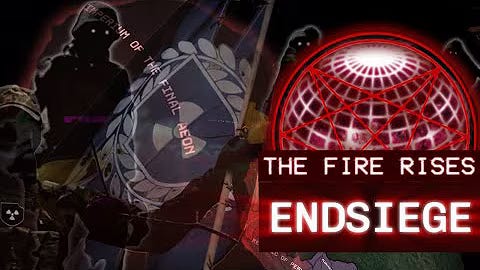
Still, as a spectator, this exposure can only go so far—and what separates TFR from a documentary or a podcast is the promise of an even deeper, more participatory level of engagement. Other forms of accelerationist-adjacent content end at the act of one-way consumption, but the spectator surface of TFR is only the beginning—a way of lowering the temperature of the mod itself and all the subject matter it entails. The bridge between spectator and player is just one click, and the potential for spectator capture is the potential to actually play the mod. But while some TFR-inspired YouTube videos have millions of views, the mod has only been rated 13,000 times on the Steam Workshop. Most people don’t — and won’t — press play. I did.
Players
According to Steam, I’ve put almost 1,400 hours into various grand strategy games since I first downloaded EU3 in 2012—and by Paradox Interactive fandom standards, these are fairly middling numbers. My playstyle varies by title — in Victoria, I inevitably find myself doing Socialism-In-At-Least-One-Country because it yields the best results; in Crusader Kings, I generally morph into a power-hungry, execution-and-castration-happy autocrat because the alternative is constant succession crises — but across every game, I tend to gravitate toward a centralized, developmentalist government with robust infrastructure spending. Because I started playing these games in my mid-teens, I’ve never spent much time thinking about this pattern in any serious depth.
If you’d asked me what I’ve learned from grand strategy games before I picked up TFR, my immediate answer would have been map literacy. Unsurprisingly, spending hundreds of hours staring at detailed reproductions of historical maps does wonders for the part of your brain that handles geography. But by rewarding me for repeatedly making one kind of decision over another for almost fourteen years, these games have also taught me the shape of a certain kind of statecraft. The same way I’ve learned to wrap leafy greens in paper towels before putting them in the fridge, I’ve learned that you need to invest in increasing your subjects’ literacy (and potential to take on industrial jobs) before transitioning into a full democracy in Victoria 3—at least, if you don’t want to end up with some kind of Agrarian Workers’ Party racking up North Korean election numbers every cycle. This, I think, is what grand strategy games do to the people who play them: the mechanics encode an argument about the fundamental moving parts of a given national, political, military, or economic project, and the player who wants to win has to internalize that argument well enough to act on it.
What makes this so easy to miss in most grand strategy games is the patina of temporal distance. As you build a Congolese rubber plantation in Victoria, order a regiment of musketeers to put down the unruly New World natives harassing your colonists in Europa Universalis, or order all Jews to be expelled from your realm in Crusader Kings, it’s easy to tell yourself that the game is simply helping you get inside the heads of people in an era mercifully far removed from your own. Even Stellaris, which begins nearly two hundred years after its 2016 launch date, does the same thing in reverse—the inherently fantastical sci-fi setup makes it hard to sit with your decision to forcibly sterilize or exterminate an entire planet of humanoid aliens in real, sober terms.
TFR‘s intervention is to strip the patina. The mod begins just a few short years before “right now,” many of the factions are real countries and political movements, and most in-game leaders are real, living people. With actors and spectators, capture is what happens when in-game avatars are used as profile pictures and game clips start trending on YouTube. With players, the same affordance finally starts to run the other way—the object reaches into the part of your mind that the genre may have already spent fourteen years training, and pulls it into a fight without any distance to soften the experience. My grand strategy political conditioning didn’t start here; TFR is just what it looks like when the project being minmaxed isn’t a historical artifact made of Wikipedia links, but a present-day movement made of Telegram channels and grisly news headlines.
Rehearsal
In my first TFR run, after taking Tallahassee, I failed to make any territorial gains beyond the state of Florida before the more established factions got their act together—and in a fair fight, my army of poorly equipped NEETs didn’t last five minutes against even one atrophied splinter of the United States Department of Defense. Watching several sober army divisions effortlessly steamroll my swastika-spray-painted tanks and hoodie-clad irregulars, I felt something like catharsis. Then, in the way I often do after losing at a grand strategy game, I found myself wondering where I might learn from my mistakes the next time around.
The experience of losing as Atomwaffen can be read as a vindication of the group’s critics, but it’s also the experience of losing at a video game—a clear, open invitation to try again and do better. This is how The Fire Rises works on people like me, capturing them through their own skills. The mod’s mechanics find easy purchase in the mental machinery I’ve built from playing a dozen other Paradox Interactive games—and if you’re anything like me, your brain is running the same optimization routines no matter which faction you play.
Granted, there’s some friction. Deploying dirty bombs feels bad, and the flavor text for events like “Solemn Penance” is hard to read with anything but horror. The consequences of your actions are not absent at a gameplay level, either: some focuses cost real population and infrastructure, and the faction has a much harder start than its rivals. Still, once you choose to commit yourself to a TFR-AWD playthrough, the work of actual resistance is all on you. You can’t play well without spending hours thinking about how their project would actually work.
What that thinking amounts to, run after run, is rehearsal—even if the logic it encodes is heavily informed by the constraints and limitations of being a mod for the video game Hearts of Iron IV. TFR doesn’t teach you how to 3D-print a Glock switch or shoot up a power substation, but it has a lot to offer at the level of strategic imagination: to play TFR-AWD is to accept the (in-game) premise that the existing order can’t be salvaged, and that you will never beat the state in a fair fight—which routes every viable line of play through asymmetry, attrition, and the deliberate manufacture of disorder. A documentary or a podcast may describe the shape of a project like Atomwaffen from the outside, but the optimization loop of grand strategy gameplay lets you build it yourself through trial and error.
The resulting knowledge transfer is smaller than the kind associated with outright recruitment, but it has an outsized ideological footprint. It’s also stickier, because it’s produced rather than received. This is where the word I started with stops feeling like decoration.
The Fire
In the original formulation of Nick Land and the Cybernetic Culture Research Unit, hyperstition is the idea that imagining a thing in detail can be the first step toward calling it into being. Many of the movements TFR depicts have been talking about themselves in these terms for years—Iron March’s open documentation of itself; the rise of “Kek” and “meme magic” on 4chan’s /pol/ circa 2015–2017; and the Order of Nine Angles’ goal of drawing “acausal” powers into the “causal” realm all tell similar stories about fictions that create belief loops. In this corner of the online far-right, memes, stories, and propaganda are how the dream is made real. Still, a definitional hyperstition requires belief to close the loop. TFR doesn’t.
Even if you’re diametrically opposed to a group like Atomwaffen, you can have a model of TFR-Atomwaffen fully installed in your head and never deploy it. No one makes more jokes about Atomwaffen than the TFR community, many of whom firmly hold that the mod’s only “good endings” come from factions on the complete opposite end of the political spectrum. But the TFR community’s familiarity with Atomwaffen — the reason they’re so good at joking about it — has been built through rehearsal.
Rather than outright belief, what TFR gives the player is more like workable strategic memory—the same kinds of mental shortcuts that make me wrap my leafy greens. For a grand strategy game, this is nothing new. But while EU3 and Crusader Kings impart similar models, it’s hard to find many outlets for a strategic memory of Ming Dynasty China or the kingdom of East Francia outside of grad school. What makes TFR unique is the way it gives the genre’s oldest trick some worrisomely viable real-world on-ramps.
While TFR isn’t a tool for recruitment, it’s a powerful system for installing infrastructure—and even if that infrastructure remains dormant, it’s still there. The mod’s capture affordance operates independently of whether you buy what the faction is selling—you just have to want to play well. This makes the resulting strategic memory much harder to see—and more disturbing. The effects of TFR exposure don’t show up in any of the places we usually look for radicalization, because the mod isn’t trying to change minds.
I am not a neo-Nazi, and The Fire Rises did not turn me into one. It hasn’t turned anyone else into one either, as far as I can tell. Still, if the mod has done to other players some fraction of what it did to me, it has widened the pool of people for whom a project like Atomwaffen’s has a recognizable shape—and lowered the activation energy for anyone who later meets the belief side through other channels. When weighed against a national military, 13,000 Steam ratings is a small number—but for a movement once understood to be around 80 people, it’s not.
When I was defeated on my first TFR playthrough, I told myself I’d try again with the APLA or UoA. Dozens of other factions offer more morally legible playthroughs, and I eventually tried my hand at several of them. But before I did, I started another Atomwaffen run.
“The fire rises,” in the mod’s title, is a quote from The Dark Knight Rises—Bane’s response when one of his men, whom Bane has just consigned to die for their cause in a staged plane crash, asks if they’ve “started the fire.” The phrase has been adopted in earnest by some of the movements TFR represents, which makes me think the developers chose it ironically. The problem, like everything else in the mod, is that this irony doesn’t survive contact with the player. I never stopped my troops from entering Tallahassee. Once you’re in the focus tree, optimizing toward whatever ending you’ve selected, the title is just a description of what’s happening on the screen. The fire is rising, and you’re the one feeding it. The mod won’t stop you, and neither, it turns out, will I.